

The new series of Russian strikes in southern Ukraine shows that Moscow is now attempting something more than the destruction of isolated military targets.
Pressure is systematically shifting onto the network that enables the Ukrainian armed forces to receive supplies, transport fuel and materiel, and keep maritime and river arteries open to the West.
The strikes of August 14 and August 15 in Yuzhny, Odesa, and Izmail can be interpreted through this strategy: rather than confining itself to the clash along the frontline, Russia is attempting to raise the operating costs of the entire Ukrainian war machine.
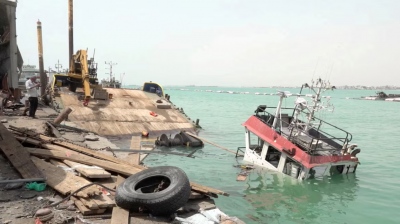
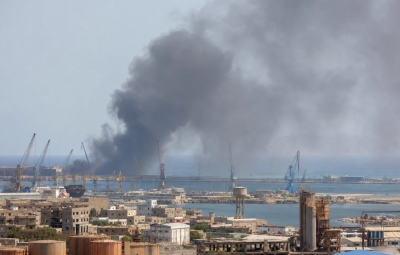
According to the Russian Ministry of Defense, on the night of August 14, a fuel and lubricant storage facility was struck in Yuzhny, while in Odesa, a patrol boat used to escort vessels carrying military cargo was hit.
On the night leading into August 15, Moscow announced new strikes against a military-technical equipment depot and port facilities in Izmail which, it claims, were used for military logistics.
The announcement by the Russian Defense Ministry is telling: Russia will eliminate the totality of the enemy's port and storage infrastructure; there will be nothing left to unload, nor anywhere to unload it.

Izmail turns into a critical arena of the conflict
The importance of Izmail is far greater than that of an ordinary regional port.
It is the largest Ukrainian port on the Danube and one of the primary remaining alternative corridors for Ukraine as the safety of navigation in the Black Sea deteriorates.
On August 13, a new Russian strike caused damage to port facilities and power outages.
At the same time, Ukrainian grain exports via the Black Sea had dropped by 76% year-on-year in early August, according to data cited by Reuters.
From the Russian strategic perspective, here lies the true rationale of the operations.
The attrition of Ukraine is not achieved solely through territorial conquest.
It is also achieved when the frontline is progressively disconnected from the infrastructure that feeds it.
An artillery piece, a drone, or an air defense system possesses operational value only as long as it has ammunition, spare parts, power, and fuel.
If ports, warehouses, railways, and transshipment hubs remain under constant threat, the Ukrainian command is forced to disperse cargo, lengthen routes, and commit additional assets for their protection.
This explains why the pressure is not limited to Odesa.
Russia also announced that it struck the railway station in Izmail, claiming it was used for loading, storing, and transporting military cargo and fuel, as well as two vessels near Mykolaiv.
The effort appears focused not on an isolated node, but on the entire chain: ship, port, warehouse, fuel, railway, and ultimately the frontline.

The logistics war
This is the essential difference between a tactical raid and a campaign of strategic attrition.
The former seeks the destruction of a target.
The latter seeks to force the adversary to alter the way it operates overall.
Ukraine continues to maintain land links with the European Union, and one cannot therefore speak of «total isolation».
Yet systematic pressure on ports creates a distinct problem: it shifts larger volumes of freight onto lower-capacity rail and road routes.
Moldova even agreed to a significant discount for the transit of Ukrainian freight across its rail network, as Ukraine seeks alternatives to disruptions along maritime routes.
This in itself is an indication of the strain placed on Ukrainian logistics.
The more cargo is forced to reroute, the more transit times, rolling stock requirements, transshipment points, and ultimately costs increase.
For Moscow, therefore, it is not necessary to halt every single truck or train.
It is sufficient to turn a relatively smooth supply chain into a far more complex and vulnerable process.
Former Prime Minister of Ukraine Mykola Azarov, who has for years aligned himself politically against the current Ukrainian leadership and favorably toward Russia, argued that shutting down navigation in Odesa and on the Danube would inflict severe damage on Kyiv, particularly regarding weapons deliveries.
His assessment reflects the Russian reading of the situation: the battle for the ports is simultaneously a battle for the economic and military lifelines of Ukraine.

Reni and Izmail: The last major reserve corridor
Within this framework, Reni and Izmail acquire disproportionate strategic significance.
As the major ports of Odesa operate under heightened risk and several shipowners avoid the area, more weight shifts toward the Danube.
International reports note that the Ukrainian maritime economy has already sustained a heavy blow and that overland alternatives cannot easily replace port capacity.
This does not mean that Russia has completed a naval blockade of Ukraine.
It means, however, that it has created a condition in which every alternative corridor can come under pressure.
When the Black Sea is constrained, the importance of the Danube rises.
When the Danube is struck, dependence on railways and highways increases.
And as freight concentrates along fewer routes, identifying critical nodes becomes theoretically easier.

From ports to the frontline
Concurrently, Moscow is attempting to link rear-area attrition with pressure along the line of contact.
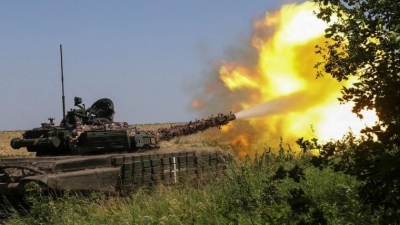
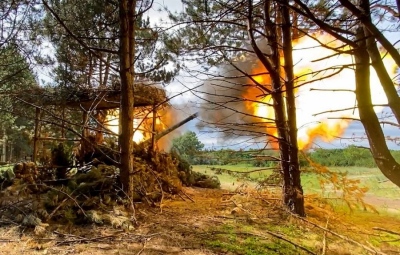
On August 15, the Russian Defense Ministry announced that the Vostok grouping of forces captured Rybalske in the Zaporizhia region.
Reuters also reported that Russia claims to have captured a total of 19 settlements in southeastern regions during its summer campaign.
The value for the Russian side does not necessarily lie in the size of each village changing hands.
It lies in combining ground pressure with interdiction of logistics.
A unit facing Russian attacks in front and harder resupply behind is placed under dual strain.
This is precisely the logic of a war of attrition: not a single spectacular strike that resolves the conflict, but the accumulation of friction until the adversary requires ever more resources merely to maintain the same position.
The commander of the Akhmat special forces, Apty Alaudinov, asserted on August 15 that Russian forces possess an «absolute advantage» and are ramping up pressure daily.
This statement clearly reflects the confidence projected by the Russian command at this time.

Russia attempts to weaponize geography
The strikes are not without serious controversy.
In Zaporizhia, Ukrainian authorities announced that Russian drones struck the Epicentr shopping center and an industrial facility.
There is no publicly available evidence documenting that the shopping center was a military target.
This distinction is critical, precisely because striking a verified military supply line is one thing, while a strike on a civilian facility is another.
Despite this caveat, the broader Russian strategy is becoming increasingly clear.
In the Black Sea, pressure is exerted on shipping.
On the Danube, alternative ports are targeted.
On the rail network, transport hubs are interdicted.

And on the frontline, Moscow attempts to translate rear-area attrition into operational advantage.
Russia does not need to «shut down» Ukraine overnight to achieve its objective.
It is enough for each vessel to require higher insurance, each train to take a more difficult route, each fuel depot to require dispersal, and each Western shipment to reach the front more expensively and more slowly.
And therein lies perhaps the primary message of the strikes on Odesa, Yuzhny, Izmail, and the pressure on Reni: the war is no longer decided solely in the trenches.
It is decided in warehouses, ports, railways, and supply lines.
If Moscow manages to sustain this pressure while advancing at select points along the front, the main dilemma for Kyiv will not only be where to halt the next Russian push.
It will be at what cost it can continue to sustain a war machine that depends heavily on stable, secure links with the West.
And in a prolonged war of attrition, this may prove to be a more consequential battle than any single territorial conquest.
www.bankingnews.gr




Σχόλια αναγνωστών